When it comes to the world of mirrors, the refractive index is a crucial aspect that often goes unnoticed by many. As a supplier of processed mirrors, I've been in the business long enough to understand the significance of this optical property. In this blog post, I'll be delving into the question: Do processed mirrors have a high or low refractive index?
Understanding Refractive Index
Before we can address whether processed mirrors have a high or low refractive index, it's essential to understand what the refractive index is. The refractive index of a material is a measure of how much the material bends light as it passes through. It is defined as the ratio of the speed of light in a vacuum to the speed of light in the material. A higher refractive index means that light travels more slowly through the material and is bent more, while a lower refractive index indicates that light travels more quickly and is bent less.
This property is fundamental in optics as it affects how lenses and mirrors function. The degree of bending of light determines how images are formed, whether they are magnified, reduced, or distorted. In the case of mirrors, the refractive index plays a role in influencing the clarity and quality of the reflected image.
The Manufacturing of Processed Mirrors
Processed mirrors are not your ordinary mirrors. They undergo a series of manufacturing steps to achieve specific optical qualities, aesthetic features, and durability. These steps can include cutting, polishing, coating, and shaping. The materials used in processed mirrors can vary significantly, from traditional glass to more advanced composites.
The base material of a mirror has a significant impact on its refractive index. For example, glass is a common material used in mirror production. Different types of glass have different refractive indices. Soda - lime glass, which is widely used in everyday mirrors, typically has a refractive index of around 1.5. This means that light travels approximately 1.5 times slower in soda - lime glass than in a vacuum.
On the other hand, some specialty glasses, such as flint glass, have a higher refractive index, often around 1.6 - 1.7. Flint glass contains a high percentage of lead oxide, which increases the density of the glass and, consequently, its refractive index.
High or Low Refractive Index in Processed Mirrors?
The answer to whether processed mirrors have a high or low refractive index is not straightforward, as it depends on several factors.
Low Refractive Index Mirrors
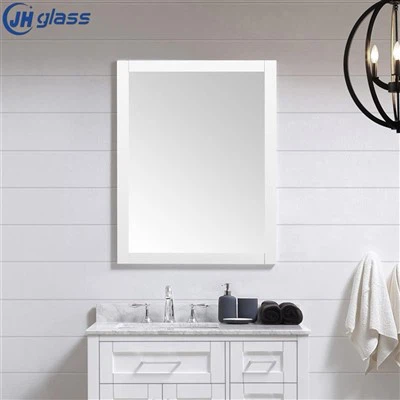
Low refractive index mirrors are often preferred in applications where minimal distortion and a clear, true - to - life reflection are required. Mirrors with a low refractive index, like those made from soda - lime glass, are commonly used in household settings. For instance, a Scalloped Bathroom Mirror is designed to provide a clear reflection for daily grooming tasks. The low refractive index ensures that the image is not significantly distorted, allowing for an accurate view of one's appearance.
These mirrors are also cost - effective to produce, making them accessible for a wide range of consumers. The relatively simple manufacturing process for low - refractive - index mirrors means that they can be mass - produced without compromising on quality.
High Refractive Index Mirrors
High refractive index mirrors, on the other hand, are used in more specialized applications. In scientific research, telescopes and microscopes often require high - refractive - index mirrors to achieve higher magnification and better resolution. These mirrors can bend light more effectively, allowing for the creation of more detailed images.
In some high - end fashion and design applications, high - refractive - index mirrors are used to create unique visual effects. A Modern Frameless Bathroom Mirror with a high refractive index can add a touch of luxury and sophistication to a bathroom. The increased bending of light can create an illusion of depth and space, making the room appear larger and more open.
Impact of Coatings on Refractive Index
In addition to the base material, coatings also play a significant role in determining the refractive index of processed mirrors. Anti - reflective coatings, for example, are designed to reduce the amount of light reflected from the mirror's surface. These coatings can have a lower refractive index than the base material, which helps to minimize reflections and improve the clarity of the image.


On the other hand, mirror coatings can also be used to increase the reflectivity of the mirror. Some metallic coatings, such as aluminum or silver, have high refractive indices and can enhance the mirror's ability to reflect light. These coatings are commonly used in mirrors that require high reflectivity, such as Frameless Arched Full Length Mirror used in dressing rooms.
Factors Considered in Mirror Selection
When choosing a processed mirror, it's important to consider the intended application and the desired optical properties. If the mirror is for general household use, a low - refractive - index mirror may be the most suitable choice. It will provide a clear, undistorted reflection at an affordable price.
However, if the mirror is for a specialized application, such as scientific research or high - end design, a high - refractive - index mirror may be necessary. The increased bending of light can offer better performance and create unique visual effects.
Conclusion and Call to Action
In conclusion, the refractive index of processed mirrors can vary depending on the base material, coatings, and intended application. Both high and low refractive index mirrors have their own advantages and are suitable for different purposes.
As a processed mirror supplier, I have a wide range of mirrors with different refractive indices to meet your specific needs. Whether you're looking for a simple bathroom mirror or a high - performance mirror for a scientific project, I can provide you with the perfect solution.
If you're interested in learning more about our processed mirrors or would like to discuss a potential purchase, please feel free to reach out. We're here to assist you in finding the right mirror for your application.
References
- Hecht, Eugene. Optics. Addison - Wesley, 2002.
- Saleh, Bahaa E. A., and Teich, Malvin Carl. Fundamentals of Photonics. John Wiley & Sons, 2007.
- Smith, W. J. Modern Optical Engineering: The Design of Optical Systems. McGraw - Hill, 2007.